Study Abroad Without IELTS in 2027: What Actually Works?
“No IELTS” is one of the most searched phrases among students planning to study overseas. It’s also one of the most misunderstood. Skipping IELTS is realistic for many students, but only if you understand what you’re skipping and what you still have to prove.
What “Without IELTS” Really Means
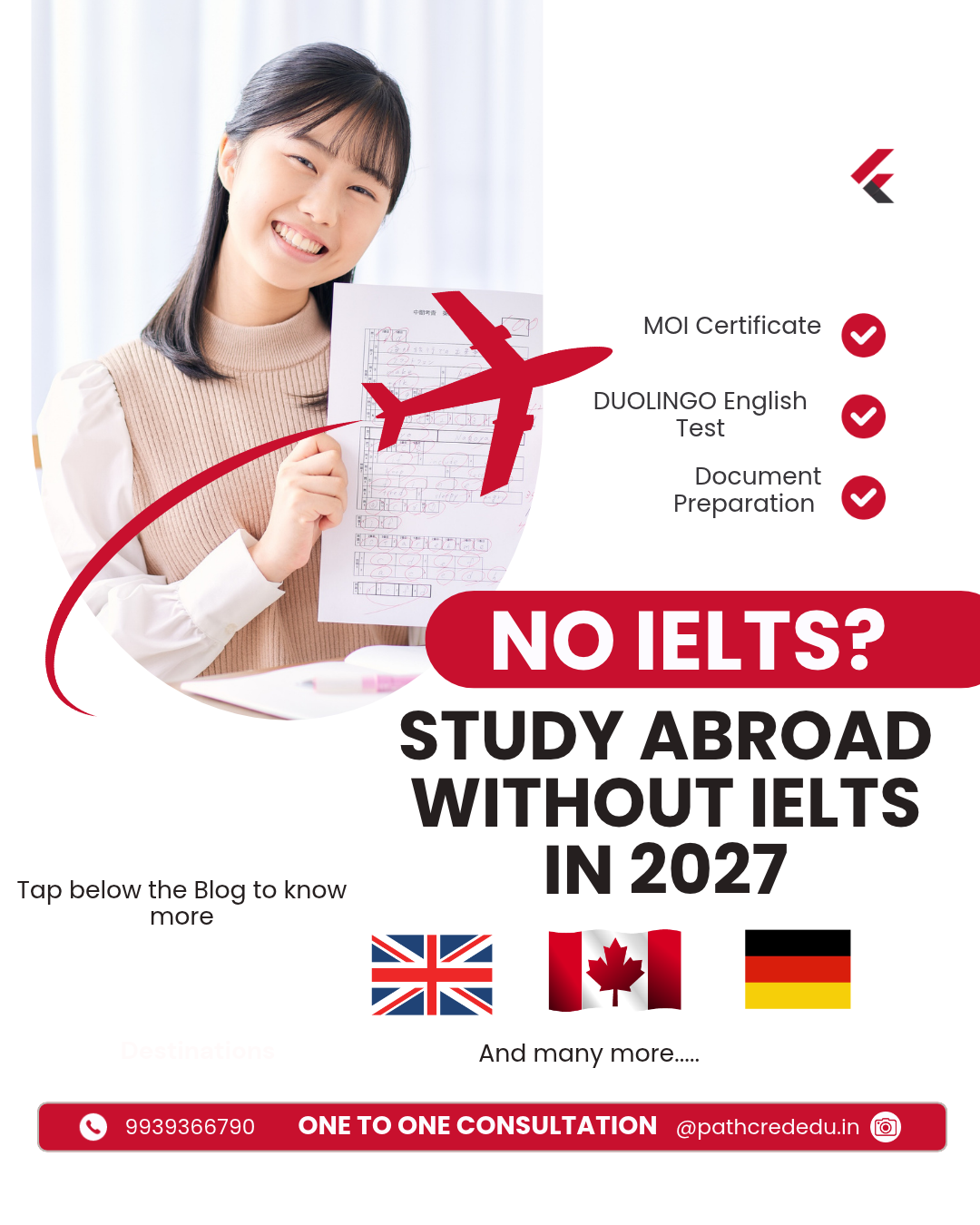
English requirements don’t disappear. Universities simply accept other evidence that you can study in English. Most consultancy and university guides describe the same set of routes: a Medium of Instruction (MOI) certificate, an alternative test such as Duolingo, PTE or TOEFL, a waiver based on English-medium schooling, or a university interview or internal assessment.
So the real question isn’t “Do I need IELTS?” but “Which proof of English does my university and my visa accept?”
The Main Alternatives to IELTS
1. MOI (Medium of Instruction) certificate. Your school or university certifies that your teaching and exams were in English. This is the most common route for students from CBSE, ICSE and English-medium state boards. Get it early, because universities can take weeks to issue it.
2. Duolingo English Test (DET). Cheaper, taken at home, and results arrive in days. Many universities in the US, Canada and Europe accept it, but it’s often not enough for visa purposes in some countries.
3. PTE Academic or TOEFL iBT. If your issue is IELTS specifically (the format, the speaking test, or a missed band score), these are still tests, but they suit some students better.
4. Waiver based on your previous degree or Class 12 English marks. Some universities waive the requirement if you scored above a set threshold in English.
5. University interview or English assessment. Some institutions run a short online interview to confirm your spoken English.
Country-by-Country Snapshot for 2027 Intakes
Policies vary by university and even by course, so treat this as a starting map, not a guarantee.
United States. Universities set their own rules, and the US visa process doesn’t require a specific English test. Many universities accept Duolingo, and some accept an MOI. Competitive programs often still expect a test score.
United Kingdom. Many universities accept an MOI or run their own English assessments. The catch is the visa side: the Home Office has its own English requirements, and UK rules have been tightening. Confirm with the university how your English will be verified for the visa.
Canada. Admission waivers with an MOI are common, but several universities and colleges still require a test, and visa officers may look closely at English ability. Check each institution’s rules.
Germany. Public universities charge little or no tuition, and some English-taught programs accept an MOI. Many still ask for a test, and German-taught programs require German.
Ireland. MOI, Duolingo, PTE and TOEFL are commonly accepted alternatives.
Australia. Universities may waive the test for English-medium students, but the student visa has its own English evidence rules. Check Home Affairs requirements, not just the university’s.
The Mistake That Costs Students Their Visa
Admission and visa are two separate approvals. A university can give you an offer without IELTS, and the visa process can still ask for an approved English test or other proof. Students who only read the university page often find this out too late.
Before you pay a deposit, do three things:
- Ask the admissions office in writing whether your English proof also satisfies the visa requirement.
- Check the official immigration website of the country, not an agent’s blog.
- Keep a backup, such as a Duolingo or PTE score, in case your MOI isn’t accepted.
Scholarships Without IELTS
Some scholarships waive the test for students who studied in English, and some research-based programs rely on an MOI or interview instead. DAAD in Germany and various university-specific awards in Canada and Europe are often mentioned, but the rules change each cycle, and some deadlines for 2027 intakes are already closing. Always check the official scholarship page.
A Simple 2027 Timeline
- 12 to 9 months before: Request your MOI certificate and shortlist universities that publish clear waiver policies.
- 9 to 6 months before: Email admissions teams to confirm the waiver in writing, and apply early.
- 6 to 3 months before: Receive offers, check the visa English requirements, and take a backup test if needed.
- 3 months before: Apply for the visa with all English evidence ready.
Common Mistakes to Avoid
- Trusting a consultant’s “no IELTS needed” claim without checking the university’s official page.
- Ignoring the visa’s English requirement.
- Applying late. Waiver decisions can take time.
- Having an MOI that doesn’t match your transcripts or degree details.
- Choosing a university only because it’s “no IELTS,” when the course, cost and outcomes don’t fit you.
Final Thoughts
You can study abroad in 2027 without taking IELTS, and thousands of students do. But the safest approach is to treat IELTS as one option among several, check both admission and visa rules, and start early. A strong profile, an English-medium education record and clear communication with universities will matter far more than any single test.
Rules change often. Verify every requirement on the official university and immigration websites before you apply.